Key Points
- Hardwood rose cuttings are best propagated from fall to late winter.
- Adding rooting hormone helps hardwood cuttings root faster.
- Winter propagated cuttings should root and be ready for planting by the following summer or fall.
Heirloom, climbing, and many other types of roses can be propagated from stem cuttings in spring and summer. But propagating roses in winter has major benefits, too—especially for hardwood cuttings which can be difficult to root during the growing season.
If you want to grow sturdier roses from cuttings, here's a look at how and when to propagate roses during cold weather and how to handle your plants once they root.
The Best Time to Propagate Roses
Roses can be propagated in a few different ways at different times of the year depending on whether you're working with hardwood or softwood cuttings.
Hardwood cuttings are best propagated during mid-fall to late winter when rose plants are in a natural state of dormancy and not experiencing active growth. Ideally, cuttings should be taken just after roses drop their leaves in fall or immediately before the flower buds begin to break in late winter; however, cuttings can be taken any time in winter as long as gardens aren't experiencing spells of extreme cold.
Softwood cuttings that are taken from new, flexible growth are typically propagated from late spring to late summer when roses are actively growing.
How to Propagate Roses the Right Way
Taking hardwood rose cuttings in winter gives plants more time to establish a sturdy root system and is a great way to take advantage of slow winter days when there's little to do in the garden. Hardwood cuttings take longer to root than softwood ones, but they will produce a sturdy and healthy root system as long as you follow these simple steps.
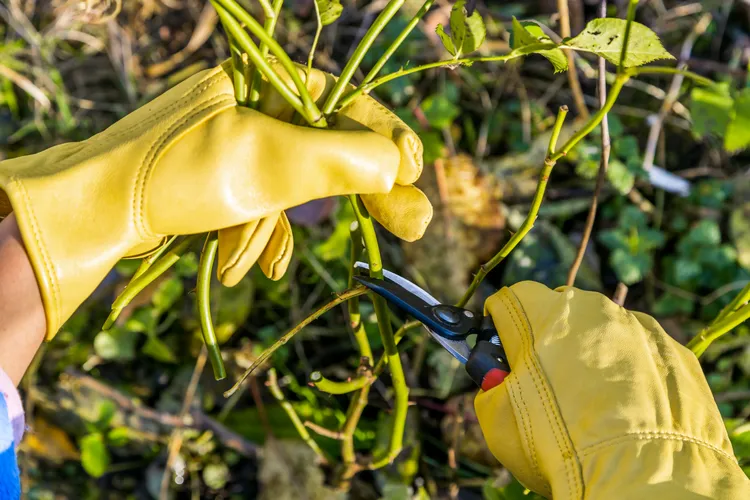
1. Prepare your tools. Select a pair of sharp secateurs to take your cuttings and sterilize the blades with rubbing alcohol or a 10% bleach solution. Make sure to wear leather gloves to protect your hands from rose thorns.
2. Select healthy cuttings. For proper rooting, choose healthy and green hardwood rose stems that were produced during the most recent growing season. Only propagate non-grafted plants as cuttings taken from grafted roses may not look like the parent plant at all.
3. Make the cut. Take 6 to 12-inch long stem cuttings by making a straight cut just below a leaf bud with your secateurs.
4. Trim the growing tip. Cut the growing tip off each cutting just above a leaf bud. Make the cut at an angle so you'll know which end is up.
5. Apply rooting hormone. Dip the bottom of each cutting in rooting hormone and shake off any excess rooting powder or gel.
6. Plant the cuttings. Insert the bottom 2/3 of the cuttings into gritty soil in a sheltered, full sun location, and space multiple cuttings 6 inches apart. If you're growing lots of cuttings, grow them in a narrow trench and dig compost and grit into the soil before planting for drainage; if you're growing just a few cuttings, fill pots with a gritty potting mix or a blend of 1 part horticultural grit or sand and 1 part compost, and keep the cuttings beneath a cold frame or in an unheated greenhouse through winter.
7. Water regularly. Leave the cuttings in place through the following fall, and water regularly to keep the soil evenly moist. If your garden experiences frost heaving, firm the soil around the cuttings as needed.
How to Plant Propagated Roses
Winter propagated cuttings should be well-rooted by the following summer to fall and can be planted into their permanent growing sites at this time.
To do this, carefully dig up the propagated roses with a shovel or gardening fork, or remove them from their growing pots, and dig a planting hole that's slightly larger than the rose root ball.
Blend compost and bone meal (optional) into the excavated soil, plant the rose crown at the same depth as the soil line or 1 to 2-inches below the soil line in cold climates, fill in the hole with the remaining soil, add mulch, and water well.
Timeline of Growing Propagated Roses
Don't fret if propagated roses don't flower during their first year! Propagated plants take a while to settle in and require slightly different care as their roots establish in your garden.
Establishment: 0 to 1 year. Roses may flower sparsely or not at all during this time. Help plants settle by watering every 1 to 2 days, adding mulch in winter, and keep pruning to a minimum.
Growth: 1 to 3 years. Plants should bloom more reliably and rose canes will thicken as their roots establish. At this point reduce watering to 2 to 3 times per week, apply light applications of fertilizer during the growing season, prune plants lightly in fall to winter, and add fresh mulch in fall.
Maturity: 3+ years. Roses should reach their mature size and flower consistently. Established plants should be watered weekly during dry spells, fertilized approximately monthly for consistent blooms, pruned annually to maintain their shape, and mulched once a year in fall.